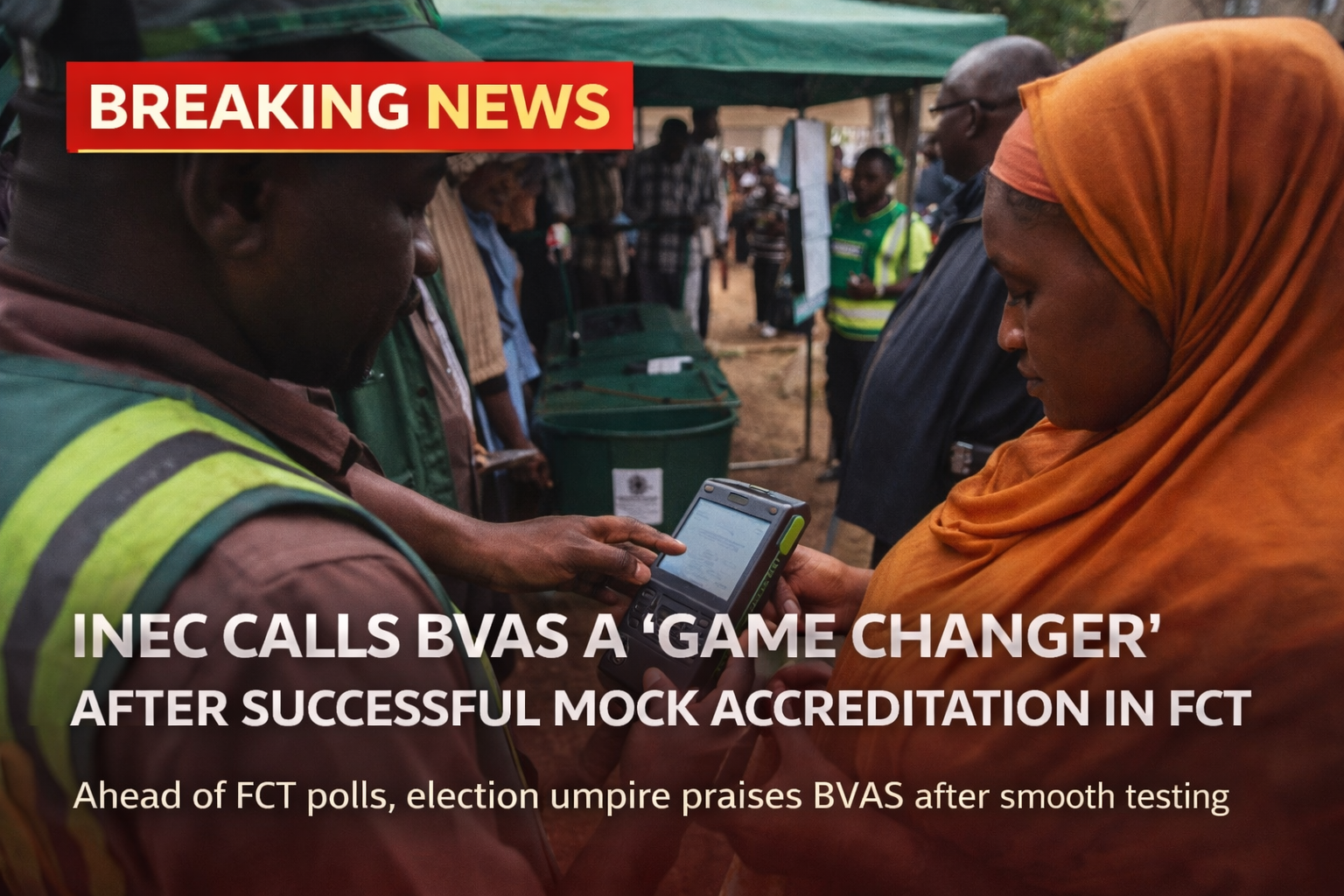
\n\nAs preparations intensify ahead of the February 21 Area Council elections in the Federal Capital Territory (FCT), Abuja, the Independent National Electoral Commission (INEC) has described its upgraded Bimodal Voter Accreditation System (BVAS) as a potential “game changer” for election integrity following a successful mock accreditation exercise.
INEC Chairman Prof. Joash Amupitan, SAN, led a high-level delegation to observe the mock accreditation on Saturday, visiting polling units across the territory, including locations in Garki, Wuse Zone 3, Ushafa and Dutse. The exercise was designed to test both the commission’s readiness and the effectiveness of the technical upgrades made to BVAS machines.
Addressing journalists during the field assessment, Prof. Amupitan emphasised that the objective was not to experiment during the actual election, but to ensure that any technical issues are resolved well ahead of time. He highlighted the speed of the device, noting that voter accreditation at the mock stations took five seconds or less per person. He also pointed out that the system effectively blocked a repeat accreditation attempt, demonstrating its capacity to prevent double voting — a major concern in Nigeria’s electoral process.
Beyond the performance of the machines, the INEC chairman inspected the training of electoral officials, including Supervising Presiding Officers, who are being intensively prepared for election day. He confirmed that non-sensitive materials have already been distributed to various Area Councils ahead of time.
Prof. Amupitan also addressed concerns about possible network challenges in rural areas. He explained that INEC has updated its operational protocols to allow presiding officers to use personal internet hotspots if regular connections fail, and noted that accreditation data will upload to the commission’s official results portal as soon as a signal is detected.
Despite the positive results from the mock run, the chairman observed that public turnout was low and urged political parties to increase voter mobilisation efforts. He underscored that while INEC is responsible for voter education, it cannot replace the role of political parties in encouraging citizens to participate in the democratic process. “You can vote today and shape your tomorrow,” Prof. Amupitan said, urging residents to take the upcoming elections seriously.
He also weighed in on the ongoing debate in the National Assembly over electronic result transmission provisions in the Electoral Act Amendment Bill, urging calm as lawmakers work toward harmonising differing positions before final passage.