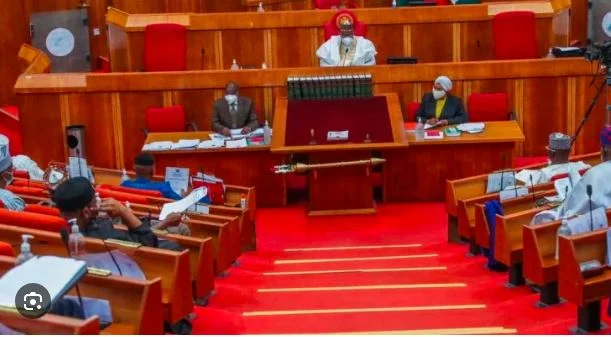
\n\nThe Senate Committee on Appropriations on Wednesday engaged in a tense exchange with the Minister of Finance and Coordinating Minister for the Economy, Mr. Wale Edun, over persistent underperformance in oil revenues and Nigeria’s mounting N152 trillion debt burden as scrutiny of the proposed 2026 Appropriation Bill began.
At a session chaired by Senator Solomon Adeola, lawmakers questioned the credibility of revenue assumptions underpinning the budget, warning that wide gaps between projected and actual oil revenues in previous years must not be repeated. Also present was the Chairman of the Nigeria Revenue Service (NRS), Mr. Zacch Adedeji, who attributed recurring funding shortfalls to unrealistic budgeting.
Adeola stressed that the document before the committee was prepared by the executive and must withstand scrutiny on grounds of realism and accountability.
“The challenges contained in this document emanated from the executive, not from us,” Adeola said. “How do we explain 18 per cent performance on oil revenue in one year and 36.5 per cent in another? Do we reduce this budget or leave it as it is? If we are not reducing it, then you are telling us you will meet the targets.”
The committee chairman also demanded clarity on whether the revenue projections presented were for the federation or strictly for the Federal Government, noting that such distinctions were essential for legislative approval and fiscal planning.
Concerns Over Debt and Asset Sales
Adeola expressed deep concern over Nigeria’s N152 trillion debt stock and the high cost of servicing it, describing current debt financing costs as “astronomical.” He suggested the executive consider disposing of certain national assets to reduce the debt burden and lower future borrowing costs.
“If some assets are disposed of and used to pay down these debts, we will reduce the quantum of our debt portfolio and reduce what we pay when we borrow again,” he said.
He urged the minister to clearly state whether the executive has full confidence in the assumptions driving the 2026 fiscal framework.
Minister Defends ‘Stretch Target’ on Oil Production
In his response, Edun defended the oil production benchmark of 1.84 million barrels per day embedded in the budget, describing it as a deliberate “stretch target” designed to drive improved output.
“It is a stretch target so that the authorities do not settle for less. But we are careful not to spend what we do not have,” he said.
Edun maintained that forward crude contracts were globally accepted financing tools and were structured to ensure that future production met obligations without jeopardising federation revenues.
Security Funding and Debt Sustainability
On security spending, the minister assured lawmakers that emergency funding had been consistently prioritised, including foreign procurement of critical military equipment.
“We all agree that security is a priority. I can assure you that emergency funding has been given. Critical foreign payments for security equipment have been made at least twice this year, including as recently as yesterday,” he disclosed.
Addressing concerns over debt sustainability, Edun argued that Nigeria’s primary challenge was not necessarily its debt-to-GDP ratio but the high pricing of debt for developing countries in international markets. He revealed that Nigeria was chairing the technical group meeting of the G24, where global experts were deliberating on debt sustainability and rising interest rates.
“The issue is pricing. Developing countries are forced to pay high interest rates in international markets. That is where the difficulty lies,” he said.
Edun noted that President Bola Tinubu had advocated the establishment of an African credit rating agency to ensure fairer assessments and more affordable financing for African economies.
Balancing Debt Servicing and Economic Stability
While acknowledging the heavy burden of debt servicing, the minister warned that undermining monetary stability could trigger exchange rate volatility and erode investor confidence. He told lawmakers that macroeconomic indicators were improving, with the economy growing at about four per cent, inflation trending downward, foreign reserves rising and the exchange rate stabilising.
He cited renewed investor confidence, including a reported $20 billion investment commitment by Shell and increased private sector participation in infrastructure development.
Edun said the administration aimed to raise total investment to 30 per cent of GDP to achieve annual growth of about seven per cent and significantly reduce poverty, adding that greater private sector involvement would ease pressure on government borrowing.
Revenue Service Chair Points to Unrealistic Assumptions
However, Adedeji shifted the focus to what he described as the root cause of recurrent budget funding challenges: unrealistic revenue assumptions. His comments underscored broader concerns that without credible projections, implementation shortfalls would persist.