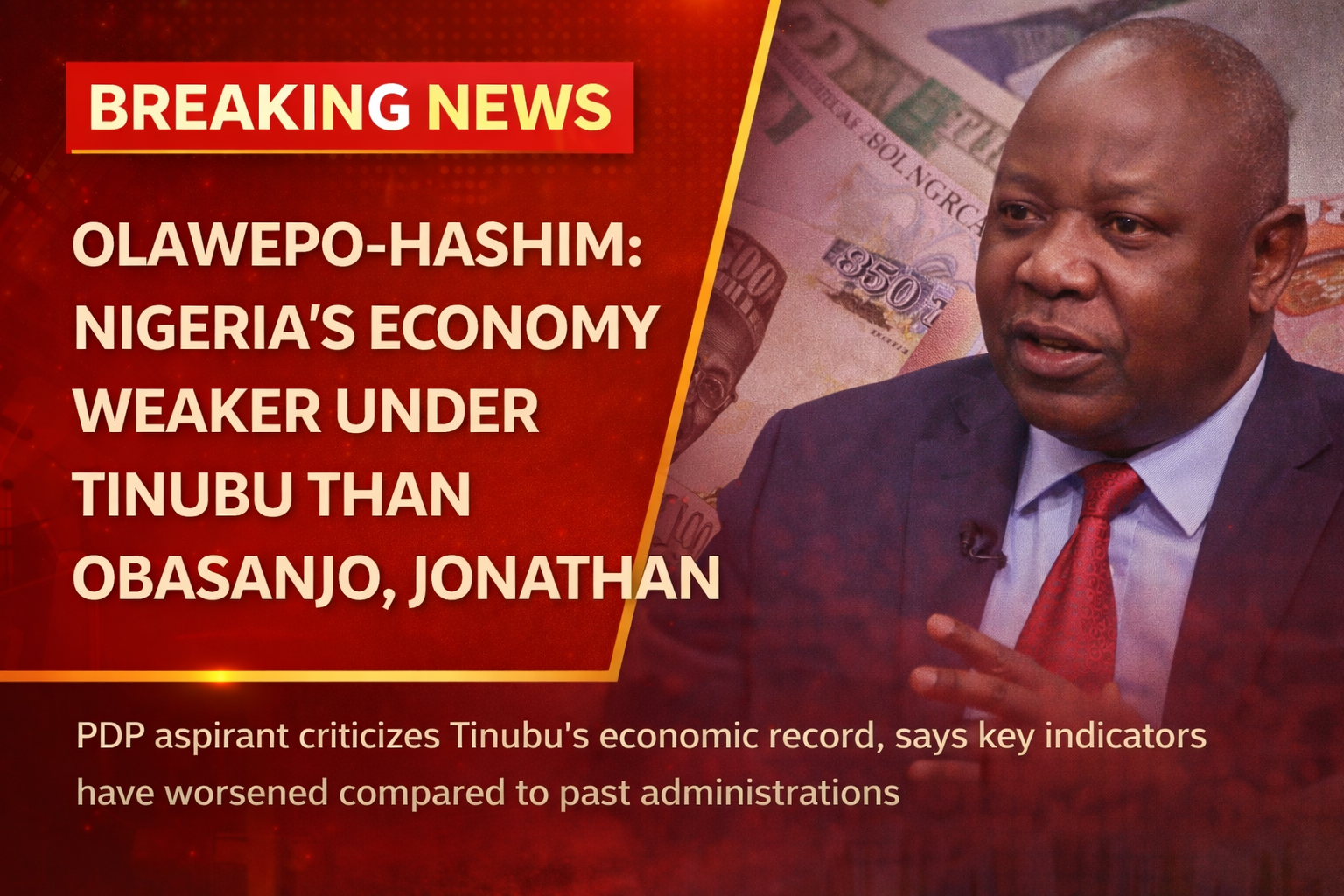
\n\nA Peoples Democratic Party (PDP) presidential hopeful, Dr. Gbenga Olawepo-Hashim, has criticised Nigeria’s current economic performance, asserting that the nation is economically weaker under President Bola Ahmed Tinubu than it was under the administrations of former Presidents Olusegun Obasanjo and Goodluck Jonathan.
Speaking on Channels Television’s Politics Today, Olawepo-Hashim argued that key economic indicators show a regression rather than progress under the current government. He highlighted nominal Gross Domestic Product (GDP) figures to make his point, noting that Nigeria’s economy was around $267 billion at the end of Obasanjo’s tenure and grew to more than $574 billion under Jonathan’s leadership. In contrast, he claimed the GDP has fallen to approximately $230 billion during Tinubu’s administration — a level he describes as “shocking” for a country with abundant human and natural resources. 
Olawepo-Hashim also drew attention to the devaluation of the naira, asserting the exchange rate has weakened far below levels justified by economic fundamentals, which he says has worsened the cost-of-living crisis and dampened investor confidence. He challenged members of President Tinubu’s economic team, including the Governor of the Central Bank of Nigeria and the Minister of Finance, to publicly defend their record in an open debate. 
In addition to GDP and currency concerns, the PDP aspirant questioned the developmental legacy often cited for Lagos State during Tinubu’s tenure as governor, comparing it unfavourably with projects completed in earlier eras. He referenced landmark infrastructure such as the Third Mainland Bridge, built under the administration of former military leader Ibrahim Babangida, to argue that some past projects had more lasting impact. 
Olawepo-Hashim’s comments reflect broader political discourse over Nigeria’s economic direction amid ongoing challenges, including inflation, currency volatility, and questions about growth relative to population expansion. His remarks are likely to fuel continued debate as the country prepares for the 2027 general elections.