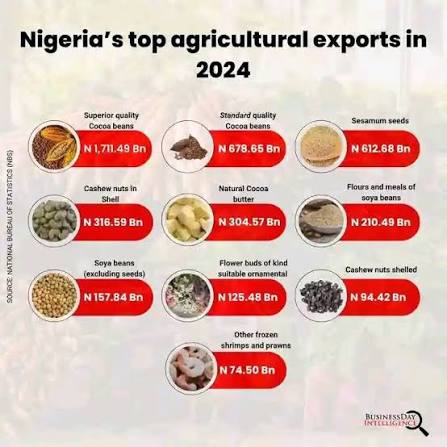
Nigeria’s agriculture sector contributes more than 22 per cent to the country’s Gross Domestic Product (GDP), yet the sector accounts for just 4.1 per cent of merchandise export earnings, highlighting the gap between agricultural production and Nigeria’s ability to compete in international markets.
The figures were disclosed by stakeholders at the fifth FirstBank Agric & Export Expo held in Lagos, where discussions focused on improving agricultural production, financing and export capacity.
FirstBank Chief Economist, Chinwe Egwim, noted that while agriculture remains an important contributor to Nigeria’s economy, its relatively small share of export earnings shows that much of the sector’s potential is yet to be converted into higher-value exports.
Stakeholders attributed the challenge to several factors, including limited access to affordable financing, weak value chains and Nigeria’s continued reliance on exporting agricultural commodities in relatively raw forms rather than processing them into finished or semi-finished products.
This means that although Nigeria produces large quantities of agricultural goods, farmers and businesses may capture only a portion of the potential economic value. Processing commodities locally could allow more value to remain within the country while creating additional jobs across manufacturing, logistics, packaging and distribution.
The issue is particularly important as Nigeria seeks to diversify its sources of foreign exchange and reduce dependence on crude oil. Expanding agricultural exports could provide an additional source of export earnings while strengthening opportunities for farmers and agribusinesses.
Experts at the event therefore called for stronger agricultural value chains, better financing mechanisms and policies that can support businesses moving from primary production into processing and export.
The disparity between agriculture’s contribution to GDP and its share of exports underscores the need for Nigeria to move beyond simply producing agricultural commodities and focus more heavily on turning those commodities into competitive products for international markets.