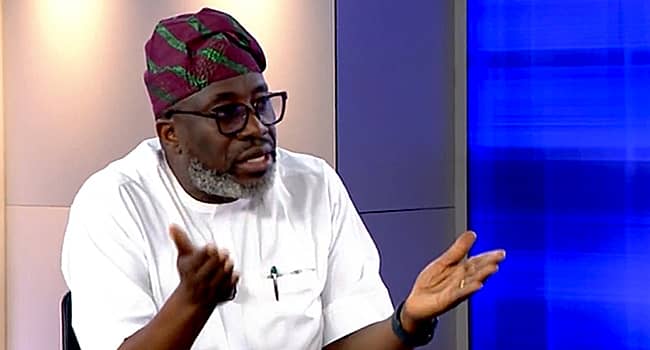
\n\nA chieftain of the opposition movement, Segun Showunmi, has attributed Nigeria’s worsening insecurity to long-standing governance failures, arguing that the crisis is deeply structural rather than driven by a single factor. Speaking at a forum on terrorism and religious violence, he said decades of corruption, policy inconsistency, and elite capture have weakened institutions and created conditions for instability. 
Showunmi cautioned against simplifying Nigeria’s security challenges to religion or regional divisions, stressing that such explanations are “emotionally satisfying” but analytically insufficient. He argued that the real issue is the manipulation of religion by powerful actors seeking control or influence, rather than religion itself being the root cause. 
He further linked insecurity to economic hardship and lack of opportunities, noting that widespread poverty lowers the “opportunity cost of violence,” making it easier for extremist groups to recruit. According to him, without meaningful access to jobs, education, and social mobility, many citizens become vulnerable to exploitation by violent groups. 
On governance, Showunmi emphasized that while the state must maintain control over security, force alone is not enough. He warned that security operations lacking fairness, professionalism, and legitimacy could worsen instability instead of solving it. 
He also raised concerns about misinformation and ethnic polarization, describing Nigeria’s information space as fragmented and easily manipulated. This, he said, undermines public trust and can distort even genuine government efforts. 
To address the crisis, Showunmi called for institutional reforms, depoliticised security agencies, inclusive economic policies, and stronger action against financiers of violence. He concluded that while there is no quick fix, sustained and disciplined leadership can move Nigeria from reactive responses to long-term stability.